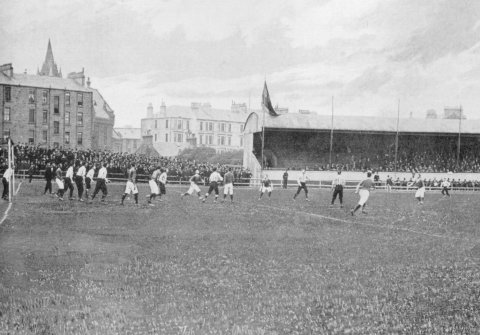
In the SFL Newsletter of 17th December, we featured the new book by the Editor of both Programme Monthly & Football Collectable and the quarterly publication Scottish Football Historian, John Litster, on the history of Glasgow side Third Lanark.
 That review into Litster’s book – ‘Third Lanark – Life and Death of the Hi Hi’ – looked at some of the many reasons that the Cathkin Park club’s life was brought to an end in 1967 at a time when Scotland could claim to be the capital of football in Europe and the World.
In this week’s Newsletter, we asked Litster to talk through some of the characters on and off the field that had a relationship with Thirds and it was no surprise to find out that there were many in the 95 years that the club was in existence from its formation in 1872.
Litster advised: “Third Lanark had their share of the greats particularly in their early days when they were at the vanguard of change in the game in Scotland.
“Queen’s Park were formed in 1867 and the first ever international match in the world between Scotland and England took place in 1872, the year Third Lanark were formed.
“When Directors realised that money could be raised from entrance fees, organised football quickly followed. Dumbarton and clubs in that area were also formed around that time and then Rangers followed.
 “Indeed, it is believed that one of the 3rd Lanark Rifle Volunteer Reserves that helped form the club was responsible for giving the Govan club their name. Harry McNeil played for Thirds and Queen’s Park before joining Rangers where his brothers Moses, William and Peter were founding members. He also played in Rangers’ first ever match against Callendar.”
The pace of change in the latter half of the nineteenth century was considerable however, Thirds held on as Litster explained: “Thirds were one of the first professional clubs, a founder member of The Scottish Football League in 1890, and I reckon that they were one of the subscribers to the creation of the Scottish Cup, which of course, is the oldest domestic trophy in the world.
“Unfortunately, I cannot prove that to be the case as unlike the FA Cup, no official record of who subscribed can be found.”
When organised football began, it was an amateur game although Litster adds wryly: “Some amateurs had a better ‘amateur’ status than others. It is well known that some amateurs were better off than other amateurs and it would be fair to say that some clubs were creative at that time as a player could be set up in a shoe shop or helped to become a publican.
 “Thirds did well when the game was growing against this backdrop with the Scottish Cup won in 1889 and 1905 with the club being crowned Champions of Scotland in season 1903/04 which was their first season at Cathkin Park.”
A dazzling star emerged at the start of the twentieth century with Litster saying: “Hugh Wilson was a real character of that time and played out a real Roy of the Rovers career and should be a member of the Hall of Fame at Hampden.
“He played with Thirds, Sunderland and Bristol City and was scoring goals from 30 yards out with the big old heavy footballs well into his late thirties.
“He only played for Scotland a couple of times however and his story is not as well known as it should be.”
Just after that golden period, Thirds had a goalkeeper, Jimmy Brownlie who was recognised more often by Scotland and indeed, kept goal for the national side for a decade.

A lean period followed for the Thirds in the 1920s when they were relegated out of the top division for the first time in their history.
Litster advised: “Thirds had very rarely been a bottom half team before this time so relegation would have been a bit of a shock.
 “Warring factions on the Board were beginning to emerge at that time and on reflection, they were rarely a cohesive club after that.”
After the Second World War had come and gone, Thirds were involved in the careers of a number of great players with the mercurial Jimmy Mason viewed as one of their best ever.
Litster said: “He was a real tanner ball player and viewed as one of the best outfield players ever at the club.
“Then you had the likes of Ally MacLeod who went on to play in a FA Cup Final for Blackburn Rovers before managing Scotland in their World Cup campaign in Argentina.
“Bobby Mitchell was there before winning three FA Cup Final medals with Newcastle United. He scored in the 1955 Final with fellow Scot, Ronnie Simpson, in goals.
 “Ironically, Ronnie’s first professional club was Thirds when he joined them from Queen’s Park five years before that Wembley triumph and 17 years before he became a European Cup winner with Celtic.”
The club actually supplied three players that went on to play in European Finals with Evan Williams copying Simpson’s feat of playing in a European Cup Final when he kept goal for Celtic in 1970 when they lost to Feyenoord.
A lesser known fact is that former red shirted player Hugh Curran appeared in the 1972 UEFA Cup Final for Wolverhampton Wanderers against Tottenham Hotspur. Curran had only played a handful of games with Third Lanark before joining Corby Town in 1963.
 The 1960s had started well for Third Lanark as just three seasons before Curran left, Thirds finished third and scored 100 goals in the top division in season 1960/61 with the renowned forward line of Jim Goodfellow, Dave Hilley, Alex Harley, Matt Gray and Joe McInnes scoring 88 of their century of League goals.
Hilley moved on to have a successful career at Newcastle United and Nottingham Forest on the park and a successful career off it as a journalist with The Sunday Post.
The seeds of the goalscoring centurions had been sown by another legendary football figure that embraced Thirds. Bob Shankly was their Manager for a seven year period in the fifties, taking Thirds to a League Cup Final against Heart of Midlothian before taking over at Dundee and leading them to First Division glory in season 1961/62.
Litster said: “Bob’s brother Bill became much better known for his success at Liverpool however, he certainly visited his sibling at Cathkin when he was the Manager of Huddersfield Town.”
 It looked like Thirds would not fare badly when they appointed Shankly’s successor when George Young took over the manager’s office.
Litster said: “With his Rangers and Scotland connections, Young was still a big name in Scottish football. He had been captain of both of these sides.”
It did not quite work out as planned with Litster saying: “It was his first and last coaching and managerial job. He left when Chairman Bill Hiddleston came in.”
“Thirds seemed to have a liking for Old Firm captains at that time as Bobby Evans, who had been the captain at Celtic had a shot at being the Manager and of course, Bobby Shearer of Rangers fame was the club’s boss when they met their demise in 1967.”
 The club also had celebrity fans with Litster explaining: “They had the first recorded celebrity following them with Music Hall star Alex Finlay proudly declaring his support for the club and using material about them in his act.
“Of course, it may have been politically better to follow a non Old-Firm side however, his support seemed genuine.”
Dame Anna Neagle seems an unlikely football supporter however, the actress born Florence Marjorie Robertson in 1904 was another Thirds follower.
Litster adds: “It is believed that she took an interest in the club’s fortunes as they were the club of choice of her father, Herbert Robertson, who was a merchant navy captain.
The final character that Litster discussed was the last captain of the club, Alan MacKay, who went on to become one of the most influential men in Scottish football.
 Litster explained: “Alan had a bit of an unfortunate time as a player. He was signed by Thirds and farmed out to Strathclyde Juniors, who played in the shadows of Celtic Park in Springfield Road. However they went burst. He then joined Thirds and they went out of existence and he joined Motherwell after that and they got relegated.”
This succession of unfortunate events may have inspired MacKay in his career choice as he became the man who insured Scottish Football clubs and associations for many a year against unexpected events.
Litster has one regret after writing the book as he reflected: “I wished I had done it 20 years ago. I would have met more of the characters involved and spoken to a lot more people with a lot of real memories of this club.
“This is just a flavour of some the gems I unearthed and as you can imagine, having been in existence for 95 years, there were plenty more.”
 THIRD LANARK - LIFE AND DEATH OF THE HI HI by John Litster
240 page large hardback book on the history of the club, and the process by which it met its end.
Available priced £20.95 plus £3.05 UK p&p (= £24) from John Litster, PO Box 3236, Norwich, NR7 7BE. Send a cheque, postal order, or for alternative methods, click www.pmfc.co.uk
The book is also on sale from the Scottish Football Museum at Hampden Park, and on eBay and Amazon.




.png)




.png)